
Bitumen tank


≈ $4,933,000

If you decide to buy equipment at a low price, make sure that you communicate with the real seller. Find out as much information about the owner of the equipment as possible. One way of cheating is to represent yourself as a real company. In case of suspicion, inform us about this for additional control, through the feedback form.
Before you decide to make a purchase, carefully review several sales offers to understand the average cost of your chosen equipment. If the price of the offer you like is much lower than similar offers, think about it. A significant price difference may indicate hidden defects or an attempt by the seller to commit fraudulent acts.
Do not buy products which price is too different from the average price for similar equipment.
Do not give consent to dubious pledges and prepaid goods. In case of doubt, do not be afraid to clarify details, ask for additional photographs and documents for equipment, check the authenticity of documents, ask questions.
The most common type of fraud. Unfair sellers may request a certain amount of advance payment to “book” your right to purchase equipment. Thus, fraudsters can collect a large amount and disappear, no longer get in touch.
- Transfer of prepayment to the card
- Do not make an advance payment without paperwork confirming the process of transferring money, if during the communication the seller is in doubt.
- Transfer to the “Trustee” account
- Such a request should be alarming, most likely you are communicating with a fraudster.
- Transfer to a company account with a similar name
- Be careful, fraudsters may disguise themselves as well-known companies, making minor changes to the name. Do not transfer funds if the company name is in doubt.
- Substitution of own details in the invoice of a real company
- Before making a transfer, make sure that the specified details are correct, and whether they relate to the specified company.

 +40 752 06...
Show
+40 752 063 138
+40 752 06...
Show
+40 752 063 138


 Turkey, Ankara


 Turkey, Ankara


 Turkey, Ankara


 Turkey, YENİMAHALLE/ ANKARA /


 Turkey, YENİMAHALLE/ ANKARA /


 Germany, Finowfurt Bei Berlin



 Ukraine, Chernivtsi


 France, Béthune


 Ukraine, Kyiv

 Ukraine, Kyiv


 Turkey, Ankara


 Turkey, Ankara

 Turkey, Ankara / Turkiye

 Turkey, Ankara


 Turkey, Ankara


 Turkey, Ankara


 Germany, Halver

 Uzbekistan, Tashkent


 Italy, Area Industriale


The bitumen terminal is equipped with a CF tank unloading ramp, a car loading ramp for 2 tankers at the same time (the skids are also equipped with scales).
The bitumen deposit functioned until the insolvency of the holder. After it’s takeover by Mavgo Holding SRL, the warehouse was modernized and the existing facilities were overhauled. Existing pipes have been replaced with double-lined pipes. All pipes have been insulated. The bitumen tanks with a capacity of 5000 m3 have been equipped with a bitumen heater (bitumen heater) that allows the bitumen to be heated in real time (when loading the car tanks) from 90-100 ℃ to 150-155 ℃, thus streamlining the process. technological and considerably reducing the costs of bitumen storage.
For the diversification of bitumen suppliers (currently Romania imports only liquid bitumen), our company has purchased a solid bitumen melting plant that will allow us to melt a quantity of about 40 tons / hour. Based on the fact that previously the steam produced in CAROM's steam production facilities was used as a thermal agent, and today this opportunity is impossible due to their non-functioning, but also from the point of view of energy efficiency, a boiler was purchased. of thermal oil with a power of 2,500,000 kcal / h that will allow us to provide bitumen tanks with hot oil to maintain the optimum temperature of the bitumen, and the smelter with the amount needed to ensure the melting process of solid bitumen.
The CF tank unloading ramp is in place. CF tanks loaded with bitumen are brought for unloading at the CF ramp related to the warehouse. The ramp has a length of 60 m (heating + unloading area) and a maximum capacity of 8 CF tanks and is arranged according to the proposed purpose. Along the ramp there is a bitumen discharge collector equipped with internal heating with thermal oil, up to an optimal bitumen aging temperature (greater than or equal to 100 ℃).
The transport of the hot bitumen (CF tank unloading phases, storage tanks loading, car tank loading) will be done by means of pumps suitable for the conveyed fluid. One pump will be used to unload the bitumen from the CF tanks and the others to load the bitumen tankers from the storage tanks or from the solid bitumen smelting furnace. Existing pumps are mounted on suitable reinforced concrete foundations, raised above the concrete floor and placed in a concrete tank (h ledge = 220mm) equipped with a drainage basin connected to the bitumen separator / sewage and rainwater collector. The pump area is covered. The roof is in water and is made of tin. The building has no walls.
a) Bitumen tanks
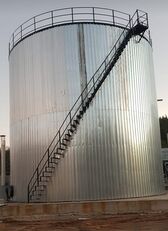
The hot bitumen discharged from the CF tanks and conveyed through jacketed routes (to limit heat loss) with the help of pumps pos P101 / 1,2 is stored in two tanks of 5000 m3 pos V100 / 2,3 and / or in the tank of 10,000mc, pos. V100 / 1 or the 200mc tank pos. V100 / 2A. The storage tanks are cylindrical, vertical, with flat bottom and conical lid, provided with internal coils, multitubular l℃al heaters having as thermal agent diathermic oil and insulation made of mineral wool protected with tin. The tanks are placed on reinforced concrete foundations, in a concrete tank with rim, base and rainwater collection channels and possible product leaks.
There are flame arrestors and breather valves on the vent connections of the bitumen tanks. At height, the tanks are equipped with temperature covers. The tanks are loaded at the bottom. The tanks are equipped with level measurements with radar sensor.
The retention tank is equipped with a contour steam network, necessary for the realization of a fire suppression curtain.
Technological equipment
For the arrangements provided at the current road bitumen station, it was necessary to integrate in the flow a series of new equipment existing on position or newly purchased. Thus, it was requested the integration in the technological flow of the 10,000 m3 tank position V100 / 1 existing on the position. The newly placed equipment is:
- Heat exchangers inside the V100 / 2.3 tanks used for heating the bitumen delivered at a temperature of 150-1550C;
- Diathermic oil boiler: which includes: oil boiler with natural gas burner, expansion vessel, vehicle oil pump, oil / gas phase separator;
- Solid bitumen melting furnace: which includes, the furnace itself, the monorai beam with two electric hoists; type bitumen conveying pump, the blower afferent to the exhaust gas basket when melting the bitumen;
- The air compressor for the automation equipment which includes the compressor itself, an air buffer and an air dryer.
In the attached equipment lists are listed all the bitumen plant equipment and their main construction features and equipment.
Automation installation
The measured parameters, indicated l℃ally or at the control panel are specified in the connection and automation technology scheme. All the execution details as well as the devices and materials necessary for the execution of the arrangements are included in the specialized d℃umentation, in a separate volume.
Road bitumen storage tanks pos. V100 / 1,2,3 are equipped with height temperature measurements with l℃al indication and transmission to the control panel but also with bitumen temperature adjustment depending on the oil flow from the heat exchangers pos. S100 / 2,3 and heating coils. The tanks are equipped with bitumen level measurements with radar sensor and alarm on maximum and minimum with interl℃king of P101 / 1.2 pumps.
It was also provided to measure the temperature and pressure of the diathermic oil on the inlet and outlet of the heat exchangers pos. S100 / 1,2.
Road bitumen loading ramps have provided bitumen flow meters loaded on each tanker. Pressure measurements have been provided on the discharge of bitumen pumps, on the steam and air routes for the automation equipment. The bitumen temperature in the bitumen melting furnace will be measured and transmitted to the control panel. Pneumatically controlled ON / OFF actuator valves have been provided on the hot bitumen routes, doubled by manual valves.
The thermal oil boilers and the steam boiler are provided with the automation equipment corresponding to the operation in conditions of maximum safety, with alarms on maximum and minimum of the values of pressure and temperature.